
CNC sliding head lathes have an established place in UK precision engineering. Their appeal is practical: accurate components, fewer separate machining operations and the ability to produce repeat orders efficiently.
For businesses manufacturing small, complex turned parts, sliding head technology can bring several stages of production into one machine. Recent investment announcements show why the technology continues to attract UK manufacturers.
What is a CNC sliding head lathe?
A CNC sliding head lathe, also known as a Swiss-type lathe, moves the headstock and bar material along the machine’s Z-axis. In guide-bush mode, the bar is supported close to the cutting tool, helping to limit deflection when machining slender components.
Depending on the model, driven tooling, a sub-spindle and multiple controlled axes allow turning, milling, drilling, tapping and back-working within the same production cycle.
The result can be a finished component produced directly from bar, with less handling between machines. Explore sliding head capabilities.
What does recent investment tell us about the UK market?
In December 2025, Star GB reported that connector manufacturer Harwin had ordered seven additional CNC sliding headstock lathes for its Portsmouth factory, with deliveries scheduled during the first half of 2026. The investment was linked to demand for its connector products and would take its Star lathe total to 56. Read the Harwin investment announcement.
Citizen Machinery also reported orders exceeding £4.5 million for 30 lathes at MACH 2026 in Birmingham. That total covered both Cincom sliding head lathes and Miyano fixed head turning centres. Read Citizen’s MACH 2026 report.
These examples suggest continued investment in precision bar turning. They do not establish a growth rate for the whole UK sliding head market, but they demonstrate that manufacturers are committing to additional capability.
Why are CNC sliding head lathes popular?
Fewer operations and less component handling
Moving a part between a lathe, milling machine and secondary finishing operation adds handling and work in progress. A suitably equipped sliding head machine can combine several of those operations in one setup.
For the right component, this can simplify the production route and reduce the opportunities for variation introduced by repeated workholding. See the production benefits of sliding head machining.
More productive machine hours
Automatic bar feeding and overlapping main- and sub-spindle operations can help manufacturers increase output from an established process. Once the job has been programmed, set and proven, suitable applications can run with reduced operator intervention.
The opportunity extends beyond high-volume work. Sliding head lathes can also suit smaller repeat batches when setup time, tooling and component complexity support the economics. Read Star GB’s application guidance.
Better control of difficult swarf
Chip control is a major consideration when planning longer production runs. Stringy swarf can interrupt machining and require an operator to intervene.
Technologies such as Citizen’s Low Frequency Vibration, or LFV, use controlled oscillation synchronised with spindle rotation to break chips. This can support more reliable production on suitable applications. When comparing machines, check the actual LFV specification and supported operations on the individual model. Learn how Citizen LFV works.
Where are sliding head lathes used?
Applications include medical components, aerospace parts, electrical connectors, hydraulic fittings and precision fasteners. The common requirement is repeatable machining of detailed components, often with several turned and milled features.
A machine’s suitability depends on the part diameter, length, material, tolerances and tooling requirements. The number of axes alone does not tell you whether it is the right choice for a job. See examples of industries using sliding head technology.
Where do used CNC sliding head lathes fit into the market?
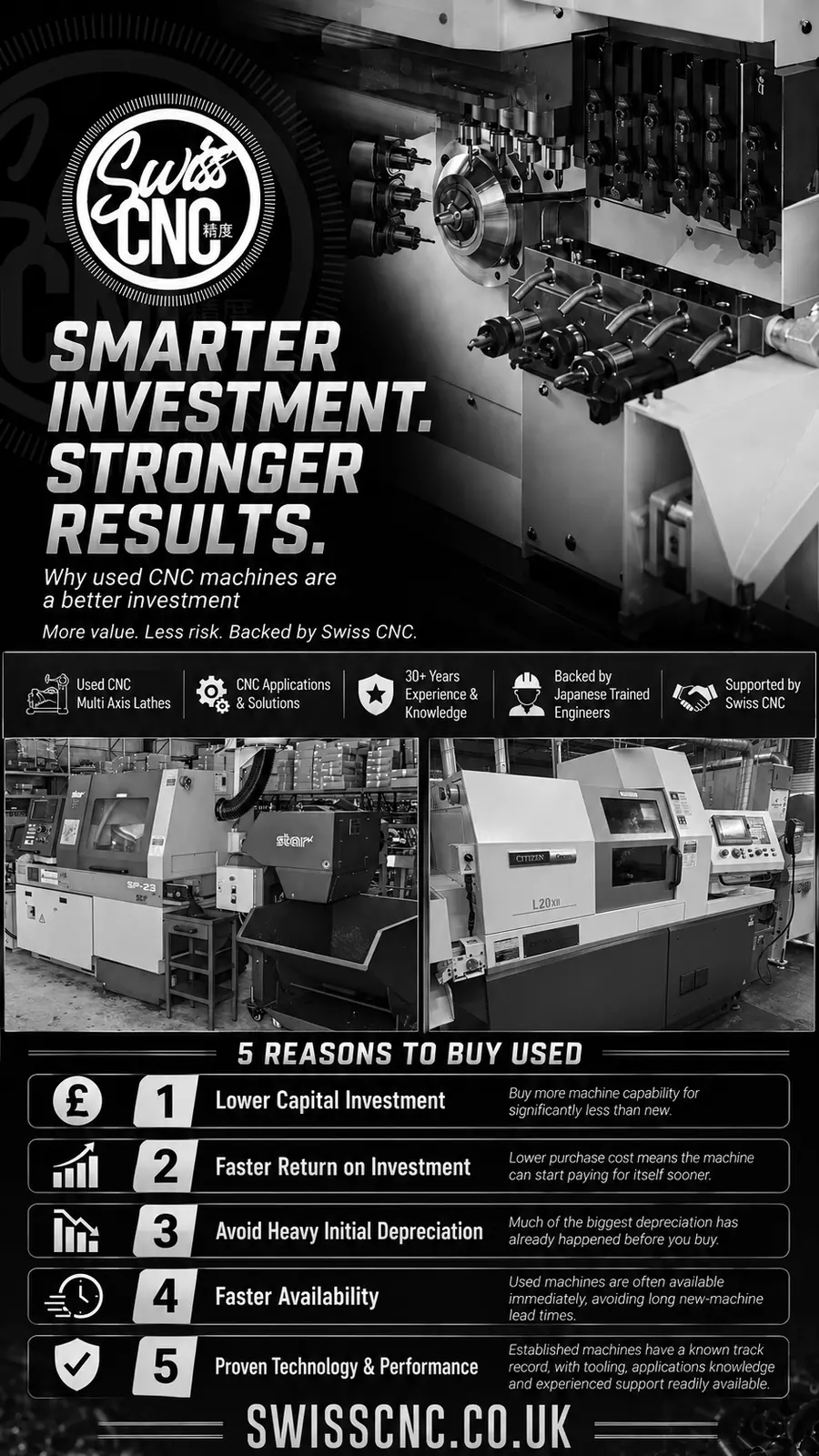
For a manufacturer considering extra capacity, a used CNC sliding head lathe provides another route to investment. A suitable machine may offer a lower purchase price than a comparable new model, while an available machine may help meet a shorter installation timetable.
However, purchase price is only part of the decision. Compare the complete cost of getting the machine into productive use, including:
- Machine condition, cutting hours and service history.
- Bar capacity, machining length and guide-bush configuration.
- Driven toolholders, collets and other included workholding.
- Bar feeder, coolant equipment, swarf handling and extraction.
- Transport, installation, programming and training.
An apparently cheaper machine can require significant additional spending if essential equipment is missing. Start with the components you need to manufacture, then assess which machine and equipment package can produce them.
Find your next CNC sliding head lathe with Swiss CNC
Swiss CNC specialises in used and nearly new CNC sliding head and multi-axis lathes, supported by more than 30 years of CNC knowledge. We help manufacturers with machine sourcing, applications, programming, delivery, installation and training. Discover Swiss CNC’s services.
Whether you are buying your first sliding head lathe or expanding an existing machine shop, tell us about your components, required capacity and production goals.
Browse our used CNC sliding head lathes for sale, or explore our CNC programming and operator training.
Call Swiss CNC on 01952 482 452 or email info@swisscnc.co.uk.
Used machines. Expert advice. Complete support.